


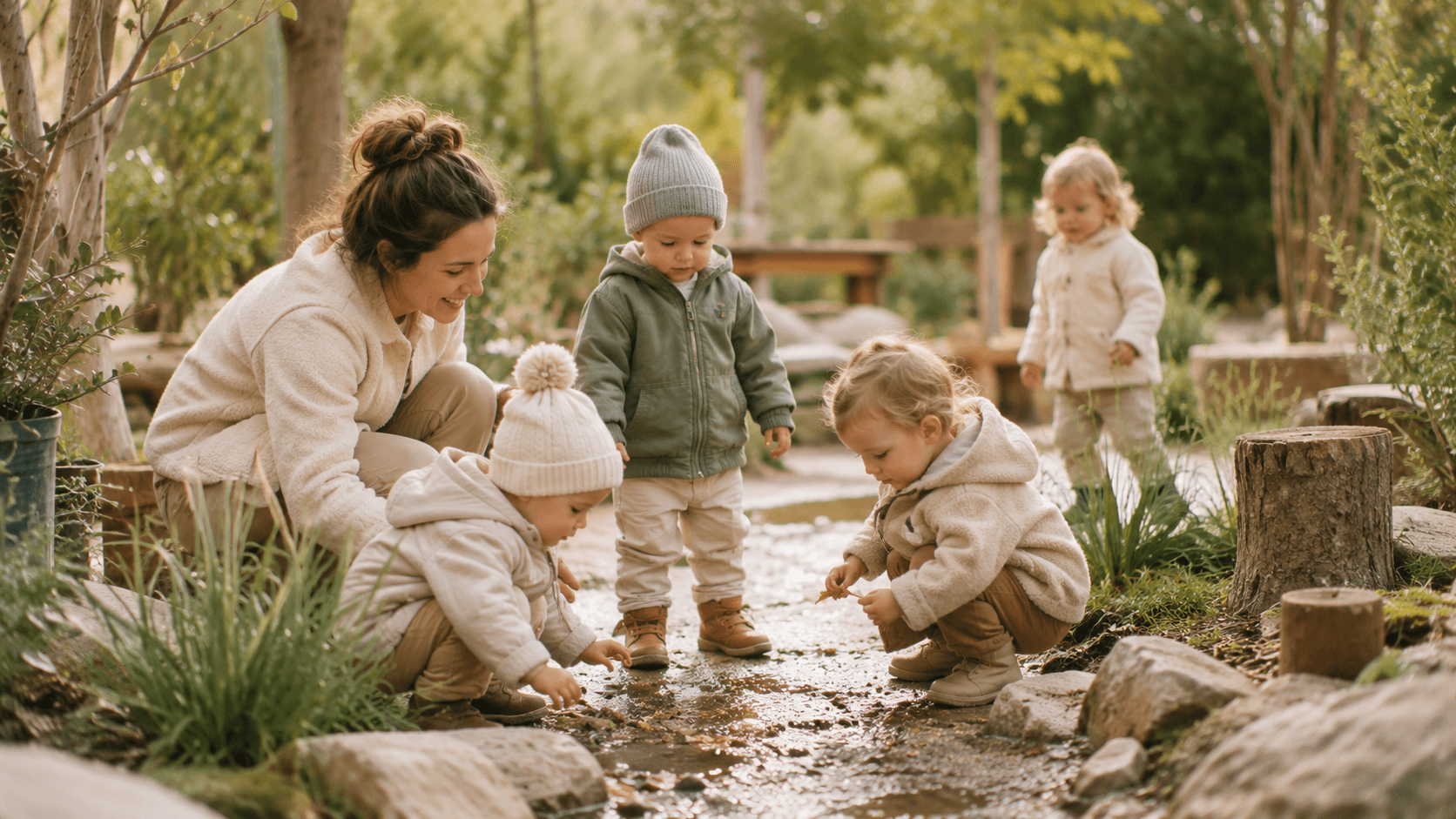
‘It’s raining. Shall we stay indoors today?’
It is a familiar question for parents. Yet child development specialists agree that regular contact with nature and daily time outdoors are among the most important ways to support development in the first three years.
Do children really need to go outside every day? How long should a walk last? And what difference does outdoor time make to their developing brains, immunity and emotions?
Let’s find out.
Should a child go outside every day?
Yes.
Specialists recommend time outdoors every day, whatever the season, provided the weather does not pose a risk to your child’s health.
Young children are still getting to know the world. Every walk brings new smells, textures, sounds, colours and experiences that stimulate their developing nervous systems.
Children learn most deeply about the world around them through direct experience.
Why is fresh air important for a child’s development?
Contact with nature supports many areas of a child’s development.
Motor development
Walking over uneven ground, sand, grass or leaves and making their way around small obstacles encourages children to keep adjusting their movements.
This develops:
- balance,
- coordination,
- muscle strength,
- body awareness.
Cognitive development
Young children learn by exploring.
They touch, watch, compare and experiment.
A puddle, a pine cone or a bird’s footprint can prompt a question and a chance to learn something new.
Emotional development
Research suggests that spending time in nature helps reduce stress and tension.
Children who regularly play outside often find it easier to manage their emotions and cope with frustration.
How much time should a child spend outdoors?
There is no single ideal amount of outdoor time that suits every child.
What matters is making outdoor activity a regular part of each day.
In practice this means:
- walks,
- playground play,
- contact with nature,
- noticing what is happening around them,
- free physical activity.
For nursery-age children, regular outdoor time matters most.
Can walks support a child’s immunity?
Yes, although not in the way popular myths often suggest.
Cold weather alone does not ‘toughen up’ the body. The benefits come mainly from:
- more physical activity,
- better sleep,
- contact with a varied environment,
- less time spent indoors.
Regular time outdoors supports children’s overall fitness and helps build healthy habits for the future.
Can children go outside in autumn and winter?
Of course.
In Scandinavian countries, children spend time outdoors all year round. There is a reason for the familiar saying, ‘There is no such thing as bad weather, only the wrong clothes.’
Rain, wind and snow can be just as interesting to a young child as a sunny day.
The key is to prepare for the weather.
What does a child gain from playing in nature?
The benefits of playing in nature go well beyond physical activity.
Children develop:
- curiosity about the world,
- independence,
- creativity,
- concentration,
- emotional resilience,
- social skills.
Nature offers a rich variety of experiences, often with less of the sensory overload found in many modern indoor spaces.
Why is contact with nature important at nursery?
For children aged one to three, the world around them is their biggest classroom.
More and more early-years settings treat time outdoors as part of their educational programme, rather than simply a break between activities.
Daily walks, observing nature and active outdoor play support development in ways that respond naturally to young children’s needs.
Learning through discovery at our Wilanów and Wawer nurseries
At Joy Babycare, we believe that a child’s learning does not stop at the classroom door.
Our children spend time outside regularly, watching the seasons change, exploring their surroundings and learning through hands-on experience.
For our youngest children, contact with nature is not an optional extra. It is part of their education.
Frequently asked questions
Should a child go outside every day?
Yes, unless there are health reasons or extreme weather conditions that make it unsafe. Daily time outdoors supports children’s development.
How much time should a child spend outdoors?
What matters most is giving children a regular, daily opportunity to be active outside.
Does a walk help build immunity?
Regular outdoor activity supports health, movement and wellbeing, which can indirectly benefit immunity.
Is it worth going outside with a child in winter?
Yes. With suitable clothing and safe conditions, children can enjoy time outdoors in autumn and winter too.
What are the benefits of contact with nature for a child?
Contact with nature supports movement, concentration, creativity, independence, social skills and curiosity about the world.
Authors: Kinga and Joanna
Kinga Czaplińska, Director of Joy Babycare & Preschool Wilanów
Kinga is a director, teacher and psychopedagogue specialising in creativity, with many years of experience running a nursery and a preschool. For almost 20 years, she has helped children and parents settle in, build a sense of security and develop curiosity, independence and creativity.
Her priority is a safe, supportive environment where every child can grow at their own pace. She is also a mother of two daughters.
Joanna Wasil, Director of Joy Babycare & Preschool Wawer
Joanna is a director, teacher and author of educational programmes. For years, she has created places where children can grow at their own pace, with a sense of safety and freedom and attentive adults alongside them. She particularly enjoys project-based learning, children’s creativity and an unconventional approach to preschool education.
A mother of two, she enjoys spending her evenings with a crime novel and a cup of tea.


